Represent Angel Graphic Tee Review: Seven Status Labels Between Payment and Doorstep — and the Two Checkpoints That Decided Our $7.76 Tee
We logged every agent status label on a $7.76 Represent angel graphic tee, then wore and washed it for four weeks. The tee earned its price; two checkpoints carried all the risk.
How we tested
Ordered at $7.76 in size L, grey-pink R447, with the variant written into the order remark. We timestamped each status change, opened the parcel on camera, weighed it, measured the tee flat at five points, then washed and wore it for four weeks before the retest.
Sources and notes
- Catalog product page
- Product listing verified on 2026-10-30.
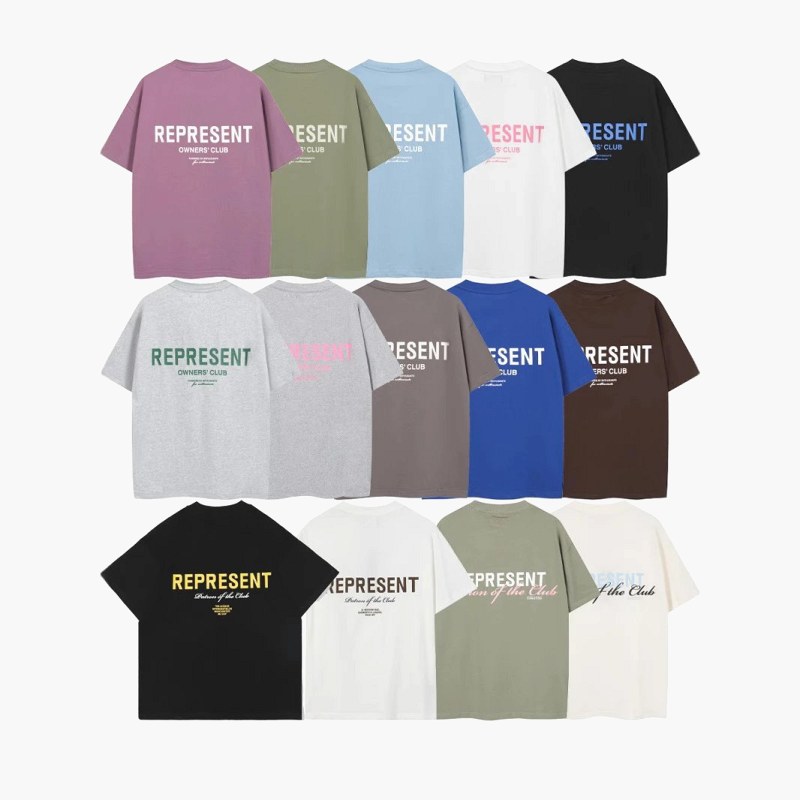
We ordered the Represent angel graphic T-shirt collection at list price — $7.76, down from a $9.26 reference, SKU 7715699507 — through the agent under review, in size L, grey-pink R447. It arrived in a grey poly mailer 19 days after payment, was opened on camera, and then went onto a hanger for four weeks of ordinary wear: two washes a week apart, line-dried, worn to the office and on a wet Saturday. This review is less about whether a $7.76 cotton tee is good value — it is — and more about the seven status labels an agent shows you along the way, because two of them are where the money and the risk actually sit.
What we ordered, and the field that decides it
The listing is not one T-shirt. It is a variant sheet: dozens of colour rows, several base graphics, sizes S through XL, and row names that mix brand shorthand with numeric codes. The seller's Chinese spec sheet lists combed cotton, a pullover crew neck, a loose cut, standard short sleeves, regular thickness, breathability as the material function, and a 180–250gsm weight band. The colour field alone runs from plain black through washed black-pink and grey-green.
That matters at checkout, because the order remark field is the only place your choice becomes a sentence a buyer can read. We wrote the row name in English, the numeric code, the size and the quantity on one line — "R447 grey-pink, size L, qty 1" — and photographed the filled-in form before submitting. When the QC photos came back, the neck label read L and the print matched the row we had named. No dispute, no rephoto request.
Seven labels, and what each one actually promises
Our log, timestamped at each change. Day 0 is payment confirmation in Rotterdam.
| Label | What it commits the agent to | Our log |
|---|---|---|
| Payment confirmed | Order accepted. Nothing has been bought yet. | Day 0 |
| Purchased | Agent has paid the seller. Domestic dispatch is not yet guaranteed. | Day 0, +5 h |
| In transit to warehouse | Seller's courier is moving inside China. | Day 1 |
| Arrived at warehouse | Stock-in logged. Your free-storage clock now starts. | Day 4 |
| QC photos uploaded | Four images: front, back, neck label, print close-up. | Day 5 |
| Awaiting your confirmation | Nothing leaves China until you approve, return or hold. | Approved Day 5 |
| Parcel submitted | Items consolidated, freight estimated, deposit paid. | Day 6 |
| Handed to line | Final packed weight and charge confirmed. | Day 8 |
| Delivered | Customs cleared, courier handover in Rotterdam. | Day 19 |
Checkpoint one: "Arrived at warehouse" is where your clock starts
Buyers routinely read the storage window from the order date. It does not run from there. It runs from stock-in, which for us was day 4 and which on a slow seller week can be a fortnight later. ACBuy's published guidance describes 90 days of free storage, a paid extension of up to another 90, a 28-day grace period to extend or submit, and automatic disposal at a cumulative 180 days. Those are the agent's stated terms, not a guarantee we could test in a 19-day order, and the live dates in your account are the ones that bind.
We approved the same afternoon, so the window never became a cost. On a single $7.76 tee, it never will. It becomes a cost the moment you are consolidating a haul and waiting on one slow seller — which is exactly the situation where a tee like this gets forgotten in a warehouse for eleven weeks.
Checkpoint two: "Submit parcel" turns an estimate into a bill
The freight figure at submission is a deposit calculated from an estimated weight. Once the parcel is packed and reweighed, the number is adjusted up or down. On a one-item parcel the movement is small; our mailer came off the kitchen scale at 0.24 kg, with the tee alone at 0.19 kg, and the listed product weight field read 0.00 kg, so the agent's estimate was the only number in play until packing. Volumetric weight was irrelevant at this size — a folded cotton tee is a flat object — but the declared-value line on the customs form is not a formality. It is the number a carrier and a customs queue will use, and it is worth writing deliberately rather than accepting a default.
What the QC set can and cannot tell you is narrower than the label suggests. Front, back, neck label and print close-up documented the visible condition and confirmed the variant. They cannot document fibre composition, colourfastness, shrinkage, or how a print behaves after four washes. For those, the garment has to reach you.
The tee itself: five points, measured flat
We measured the size L flat, on a table, against the listing chart and against a control crew neck we keep in the workroom.
| Point | Our measurement | Note |
|---|---|---|
| Chest, pit to pit | 57.5 cm | Inside the chart's figure for L; the loose cut is real, not marketing |
| Body length, shoulder to hem | 70.5 cm | Lands at the hip, not below it |
| Shoulder, seam to seam | 51.0 cm | Not listed on the chart; recorded for our file |
| Sleeve, shoulder seam to cuff | 21.5 cm | Ends mid-bicep, as the product images suggest |
| Hem width | 56.5 cm | A centimetre narrower than the chest, so the body hangs straight |
The fabric reads as the lower half of the listed 180–250gsm band: opaque in daylight, cool against the skin, and light enough that a dark variant does not show undershirt seams. Combed cotton is a claim we cannot verify by hand, but the surface is smooth rather than slubby and it did not pill at the underarm during four weeks.
Seams were the least dramatic part of the garment, which is a compliment. Single-needle hems on the sleeve and body, a clean shoulder join, no loose thread longer than a few millimetres, and a neckline that held its shape through the washes because we dried it flat on a line rather than hanging it wet.
Print, water and the brand's own caveat
We washed inside out at 30 °C, no softener, line-dried indoors, four times. After the third wash a hairline crack appeared in the diagonal of the wordmark's first letter; by the fourth it had widened slightly but the letter was still fully legible at a metre. Represent says as much itself:
Each Piece Will Age Uniquely – Cracked Print May Lose Ink Over Time
So this is a garment whose graphic is designed to degrade. If you want a print that stays crisp, that sentence should end the decision for you. If you want a washed, worn-in look within a month, the ageing is ahead of schedule but in the intended direction. The brand's care guidance — inside out, 30 °C, no tumble drying — is not optional advice on this one; the print is the fragile component, not the cotton.
Fit, and the sizing evidence we trust least
Our size L fits like a roomy large: enough space for a hoodie underneath in winter, no billow at the waist in summer. Community reports describe Represent tees as running roomy, and several buyers who take a medium elsewhere take a small here. Against that, at least one reviewer who sized down found the result tight. That contradiction is not something a chart resolves on its own, but it is the safest instrument available: measure a tee you already like, compare it with the listed chest and length, and treat the loose cut as a reason to keep your normal size rather than reach for a smaller one.
How we would order it next time
- Write the variant row name, its code, the size and the quantity on one line in the order remark, then screenshot the form.
- Request the print close-up as part of the standard QC set — on a graphic-led tee it is the photo that decides the call.
- Approve within a day of the QC upload if the photos are clean; storage time is not free value, it is a deadline.
- Read the declared-value field before paying freight, and record the final packed weight against the estimate.
- Wash inside out at 30 °C and never tumble dry. The cotton will outlast the graphic by a wide margin.
Editor verdict
A $7.76 combed cotton crew neck that arrived as ordered, measured close to its chart and held its seams through four washes. Roomy, breathable, with a print the brand admits will crack. The risk sits in the agent's checkpoints, not the tee.
- What works
- Breathable combed cotton in the lower half of the listed 180–250gsm band
- Genuinely loose crew neck cut, with dozens of colourways in one listing
- Clean seams and no shrinkage after four 30 °C washes, line-dried
- Watch-outs
- Print is built to age; the brand warns the cracked graphic loses ink
- Sizing reports conflict, so the chart is the only dependable guide
- Variant rows are inconsistently named, making the order remark essential
Who this is for
Buyers who want a cheap, roomy cotton graphic tee for summer rotation and will confirm size against the chart before paying.
Who should skip
Anyone who needs a print that stays pristine, a close-fitting tee, or a garment they can order from the title alone without checking the variant row.
View recommendation ↗Read the full disclosure →Frequently asked
Does the "Purchased" status mean the seller has shipped?
When does the free-storage clock start?
Does the Represent angel tee run true to size?
Keep reading on this site
- No articles have been published yet.